
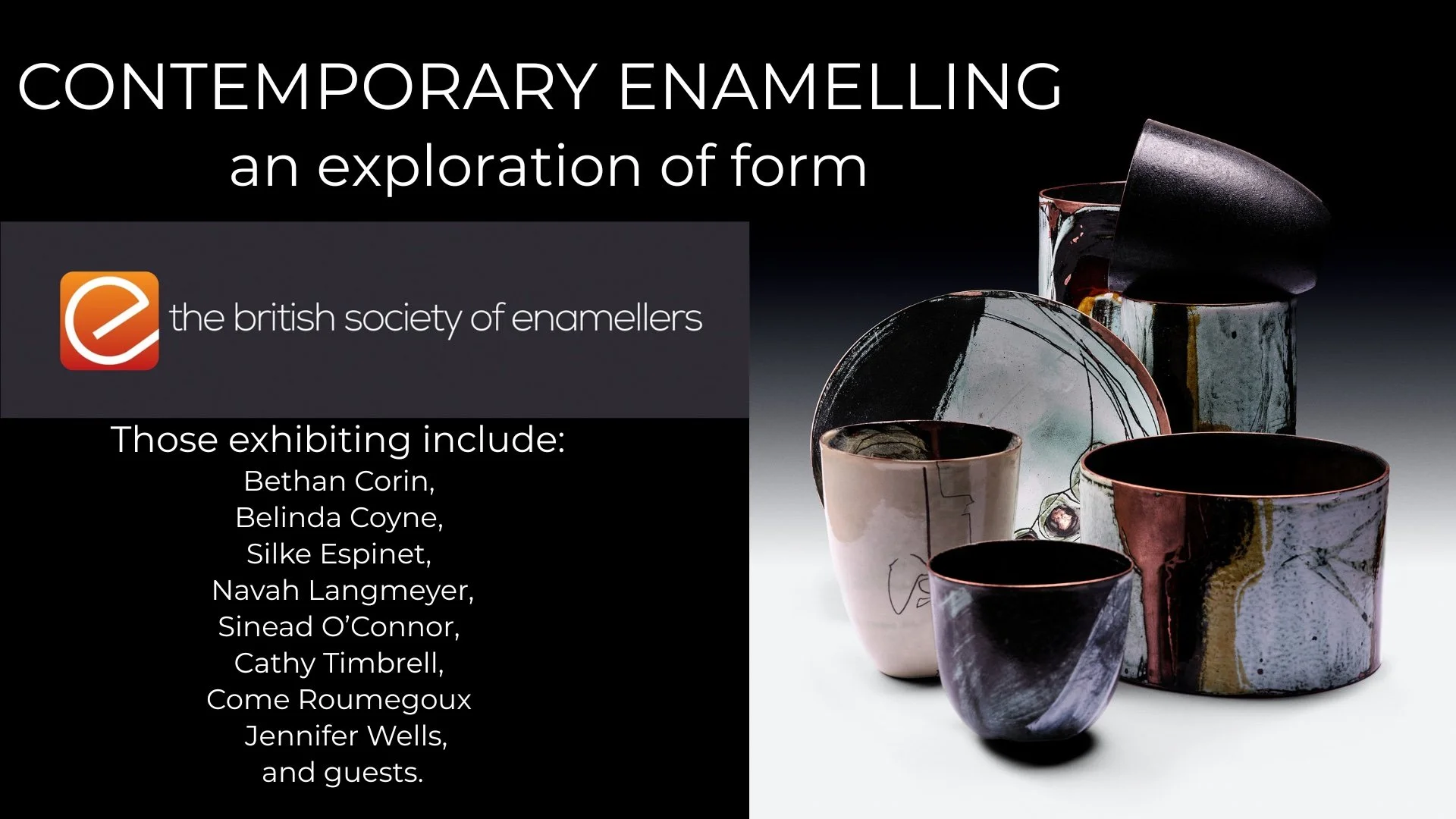
The Poly, 24 Church Street, Falmouth, Cornwall, TR11 3EG
Tuesday 8th to Saturday 12th September, 2026
The British Society of Enamellers present a show of contemporary enamelled vessels and wall hung artwork. These works show the versatility of kiln-fired vitreous enamels which, when fired onto a metal base such as copper or steel, produce unique pieces. A “conversation” could be had around the influence of ceramics and enamelled art on one another. Eight artists will be exhibiting their work for sale, including two local artists Belinda Coyne and Sinead O’Connor. In addition, the Society is showcasing enamelling techniques that have influenced current practices, including work from the world-renowned enamellers Jane Short and Maureen Carswell.
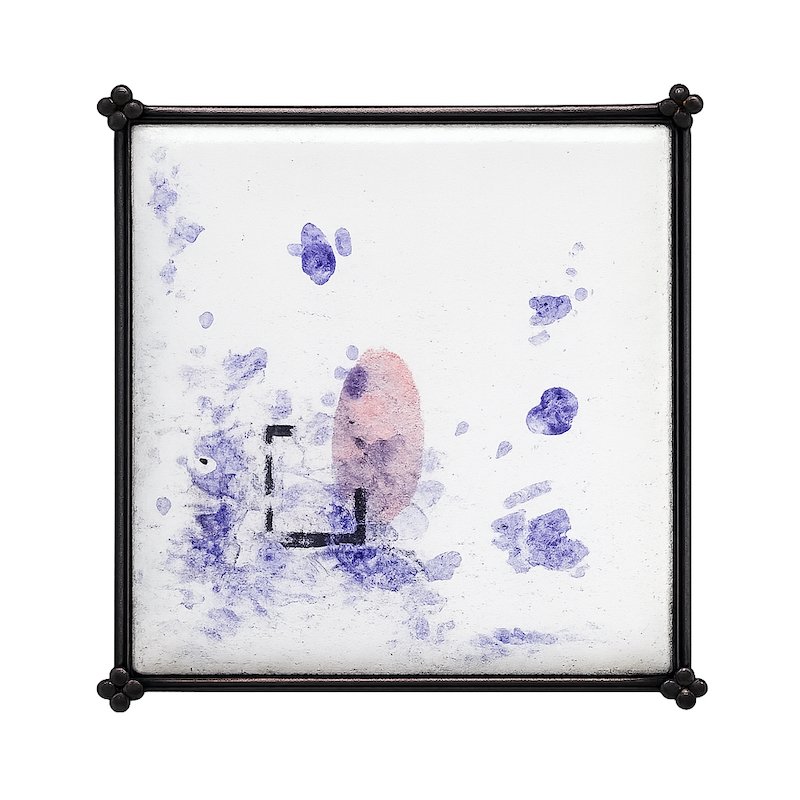
Based in North Wales, Bethan Corin makes from her home studio. Enjoying the endless opportunities for experimentation available with enamelling, Bethan creates wearable pieces full of contradiction. Enamel, alternating between perfectly smooth glossy finishes, emulating manufactured enamelware, and beautifully matte or textured surfaces. Restricted colour palettes applied in a painterly fashion against forms of a linear nature with strikingly clean lines.
The samples I have a created for this application indicate an exploration for a new collection. As a jeweller my enamel practice has taken a back seat recently but this opportunity to explore enamel as an art away from the wearable has given me the space to taken on ideas in a more playful, less restrictive way. Layering wet, sifted, onglaze and graphite has been a welcome return and I hope to also take this on to some 3D forms.
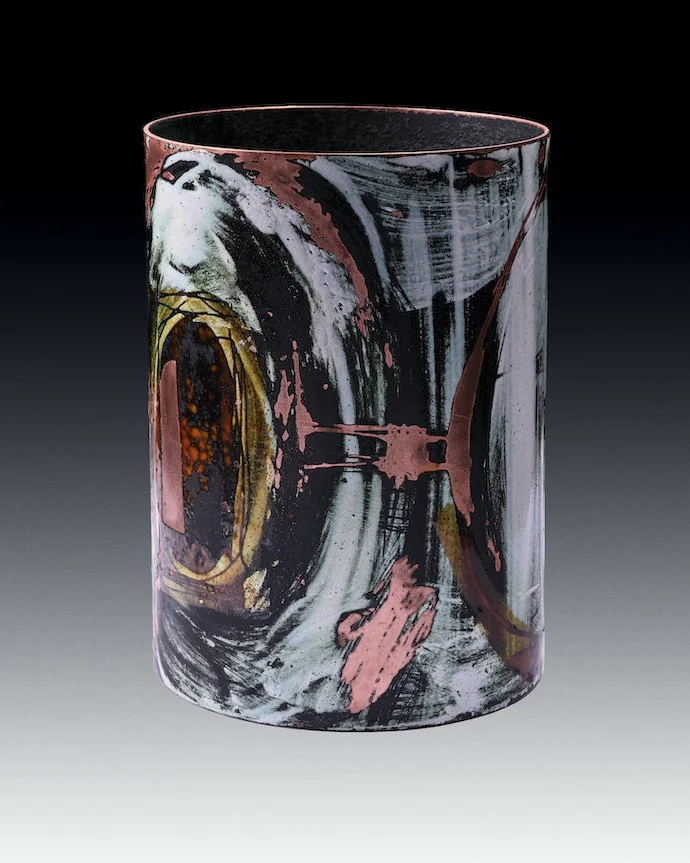
Belinda is an artist whose enamelling and metalwork reflect her layers of experience and accumulated memories of diverse landscapes. Her approach to enamelling is expressive and intuitive, grounded in a craft-making tradition but defined by a contemporary approach to application methods, scale, and conceptually engaging with an environmental agenda. She explores notions of space and place using a visual framework of grids, maps, and geometric notation that quantifies space; statistical information layered within an emotional response.
She begins by applying hand-painted and wet-process sprayed enamel to copper and steel, panels and bowls. Utilising the properties of the metal to enable extensive reworking and physical intervention.
Belinda incises, rubs, sgraffitos, and brushes back the initial layers, creating gestural marks that echo the landscape. After each kiln firing, she uses a wet stone polisher to abrade the enamel surface, which reveals not only surface marks but also those embedded within the piece.
Through the further interplay of opaque and transparent sieved enamels and her own enamel decals, she builds visual depth and complexity. Her work is defined by a continual rhythm of addition and subtraction, resulting in pieces that function as quiet dialogues between the landscape and the viewer, inviting them to explore the underlying narrative and agenda rooted within the work.
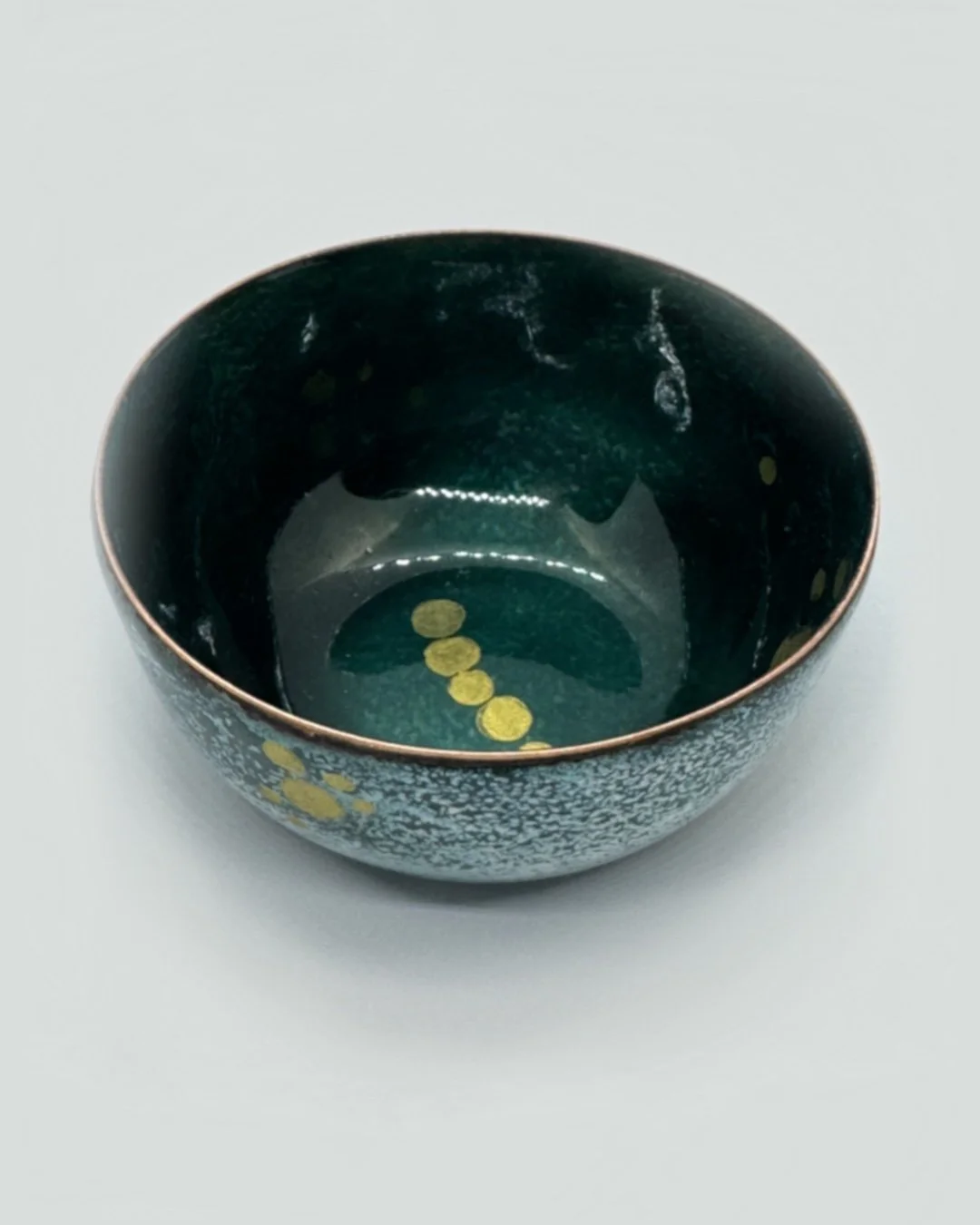
Silke Espinet
Silke is an enameller and jeweller who graduated from London Metropolitan University in 2012. Her love for the wonderful colours of the natural world led her on her enamelling journey. Silke is a multi-media artist passionate about the environment, and the protection and preservation of wild animals and insects. The last few years have been spent predominantly enamelling, both small pieces and beads for jewellery, with the main interest being vessels. She started enamelling trinket dishes and bowls, and has continued working with larger spun copper bowls (up to dimensions of 18x11cm) for the last two years. Silke also raises some of her enamelled bowls from copper. Her fascination with colours and natural, organic materials, also gems, informs her pieces. Most of the bowls have striking individual colours like bright yellow, green, red or white. However, Silke also loves the powerful and magical effects that mixing colours and enamels can achieve, with breakthrough impacts giving endless wonderful finishes. She constantly tries new enamel combinations. Silke still loves the look of copper, and uses various fluxes to keep wonderful copper impressions on some of the bowls. She is currently working on a new collection of handmade shell bowls. Her jewellery is informed by the natural world as well. Among her pieces are bold enamelled pendants and rings, electroformed necklaces and bracelets featuring precious stones and shells. Silke is a member of the British Society of Enamellers, the Guild of Enamellers, the Society of Designer Craftsmen and the Association for Contemporary Jewellery.
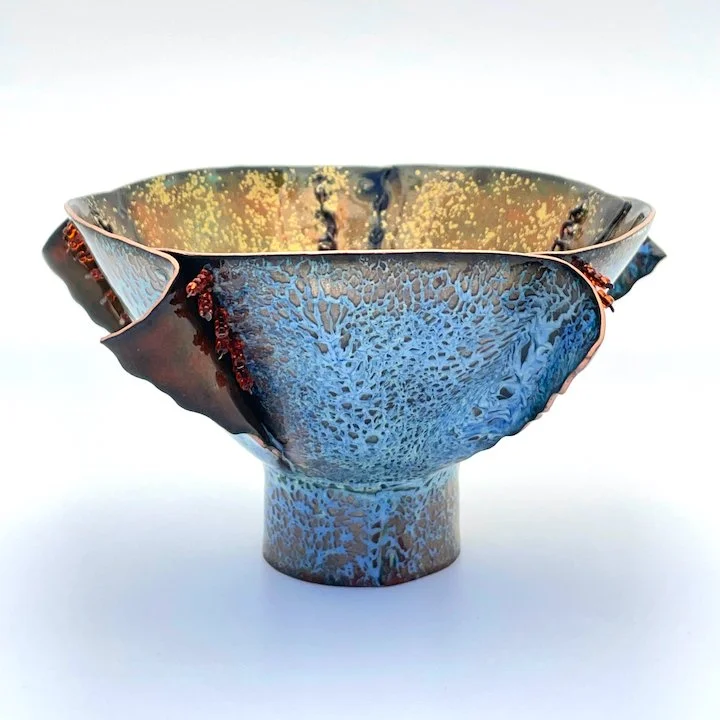
My work is largely material-driven and incorporates traditional, experimental, and unconventional approaches to enamels, metals, and alternative elements to yield sculptural effects. I’m fascinated by the characteristics of enamel and the widely-varied results possible with the medium. All my construction uses cold connections rather than solder, which adds an additional, appealing aspect of puzzle-solving to my process. Every piece is a one-of-a-kind experiment. I discover many of my techniques by accident, and have come to appreciate my failures almost as much as my successes (eventually).
The starting point for each of my pieces is often water, particularly the ocean, as I’ve never met a body of water I didn’t like. However, the broader landscape, my mathematical background, current events, and pretty much anything I observe or experience can provide inspiration. My work ranges from quite literal, if whimsical, representations to abstractions attempting to capture a particular mood. The common element running through the entire body is a focus on eye-catching, vibrant colour and texture.
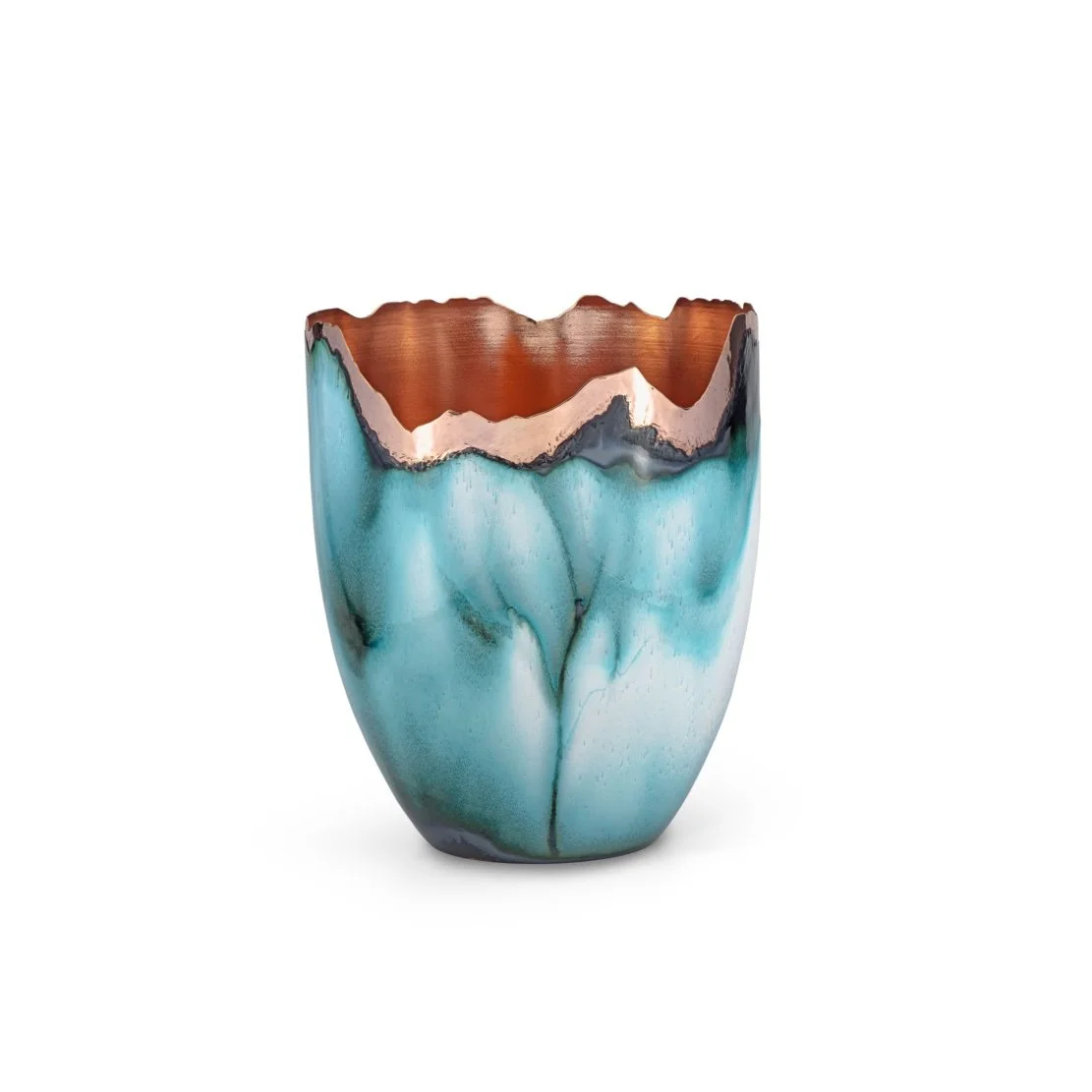
Sinéad O’Connor creates contemporary enamelled works that explore the interaction between glass, copper, and heat. By using the chemical reactions of her materials, she pushes them to create interesting unique pieces of art.
Working primarily with copper and white glass, Sinéad employs copper oxides to transform enamel colours, using techniques such as sifting, sgraffito, and overfiring. She often textures her copper surfaces to catch the enamel within indentations, highlighting the fluid movement of the glass under intense heat. Many pieces feature enamel pulled back to reveal the copper beneath. Most of her copper forms are handspun to her design by master craftsperson Warren Martin in Sheffield.
Sinéad’s deepening expertise and fascination with copper have driven her progression. She has developed from creating small, tactile bowls to producing large-scale statement pieces for galleries and collectors.
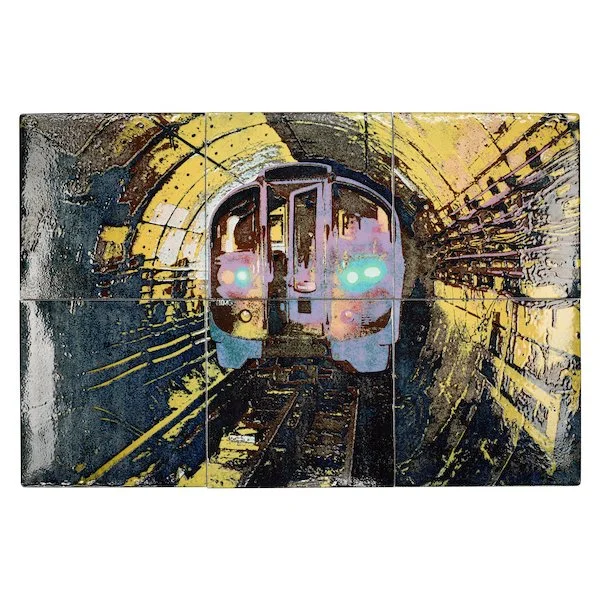
My practice combines the raw energy of graffiti with the precision and luminosity of copper enamelling, a centuries-old craft rarely encountered within contemporary art. Through this material contrast, I explore themes of chaos, control, and transformation, creating vibrant, richly textured surfaces that hold both tension and resilience.
Rooted in my experiences within the underground graffiti scene, the work reflects a personal journey of recovery and reinvention. The process of enamelling, layering, firing, and refining has become meditative, transforming fragments of the past into something enduring and luminous.
By bridging street culture with fine craftsmanship, my work challenges traditional boundaries between urban expression and contemporary art, inviting reflection on both material and meaning.
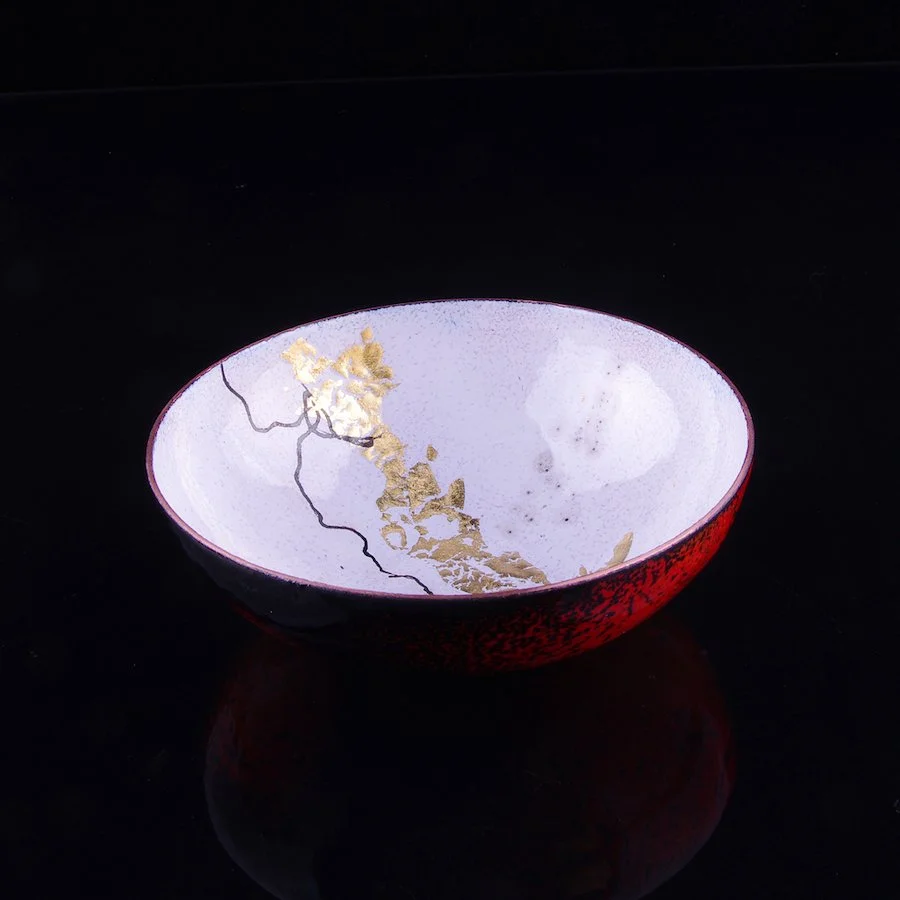
I enamel small copper bowls which are now spun for me to my designs, by Warren Martin in 1mm thick copper. Many of my designs rely on the interaction between the copper oxide formed on the bowl during it’s first firing and the different white enamels that I apply. There is often a theme or story to each bowl. Some are fired at 950oC (high firing) although more recently I have worked at lower temperatures to limit the copper interactions with the enamels and themselves. My designs are simple, often with a Japanese feel. I use sgraffito, application of fold and silver foils, simple naked raku with organic materials and liquid enamel brushstrokes. Cutting away sections of the copper is also a feature of the vessels. My colour palette relies on a fairly limited number of colours, black, red, whites and greens with clear fluxes being used to show the base copper underneath as a gold accent.
https://www.cathytimbrelljewellery.co.uk/
https://www.instagram.com/cathytimbrelljewellery/
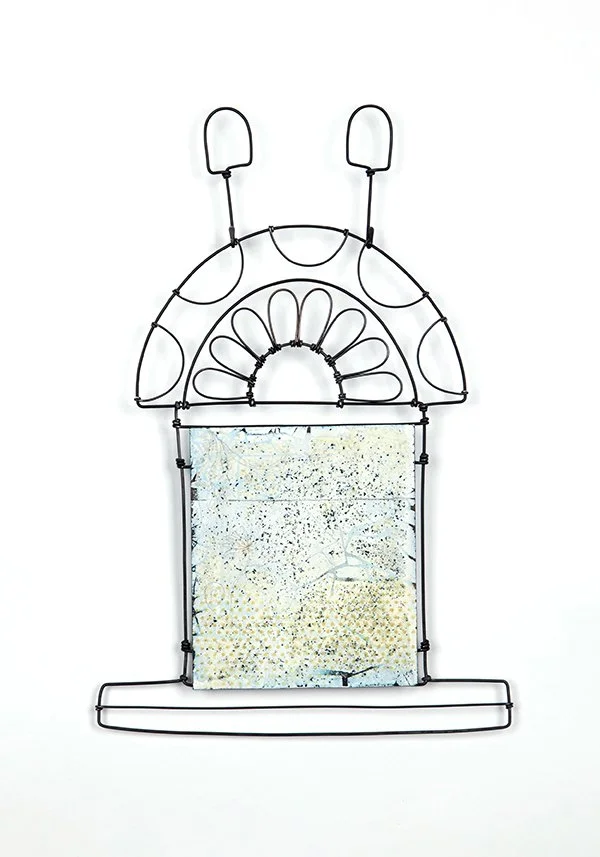
Jennifer Wells
Inspired by the worn, man made surfaces, this body of work references wall shrines and reliquaries; paying tribute to the passage of time and the moment in which we exist. Specific areas in the enamel are intentionally worn away or covered, adding layers to the narrative that exist within the work and referencing the repetition of a movement or process. The religious reference of shrines and reliquaries touches on practices, meditation and the habits we repeat in our daily lives.